

Kokonut connects the systems a regenerative farm needs.
The Problem Statement defines six coordination gaps around productive land: capital, infrastructure, evidence, participation, markets and value, and learning. Kokonut’s response is not one DAO, one token, one farm template, or one software platform.The solution is an interoperable coordination system: use the right mechanism for each responsibility, connect those mechanisms through shared standards and evidence, and let local farm operators remain responsible for the land.Adelphi is the first live reference implementation of that approach.
Inspect the live reference farm
Start with Adelphi’s public records and MRV activity before evaluating the broader coordination model.
See the coordination layers
Understand why capital governance, contribution coordination, farm operations, evidence, and infrastructure use different mechanisms.
Kokonut is designed around separation of responsibility. Shared infrastructure creates interoperability; it does not eliminate local judgment, agricultural risk, market risk, governance risk, or the need for human review.
The solution at a glance
Moloch DAO — coordinate capital
The live Moloch DAO on Gnosis Chain coordinates treasury membership, stablecoin capital, proposals, voting, execution, and rage-quit protections.
Guilds — coordinate contribution
Contributors coordinate domain work through Guild pathways so useful participation does not require entering through capital.
Framework — share a common baseline
Farms use shared data structures, development phases, regenerative principles, MRV expectations, and impact methods while adapting implementation locally.
Farm operators — execute locally
Local operators make real-world agricultural decisions about land, crops, water, labor, timing, maintenance, and farm operations.
MRV + Hub — make activity inspectable
Farm records, field observations, remote sensing, harvest data, and attestations support public evidence and reporting.
Intelligence + agents — improve coordination
Kokonut Intelligence provides active data and analytical infrastructure; more advanced agent automation remains an expanding and developing layer.
How the solution answers the problem
Kokonut therefore does not claim to remove risk.
It aims to make coordination, evidence, accountability, and learning more reusable and inspectable.
How the system flows
The solution is better understood as a feedback system than as a top-down chain of command. The loop is:- Capital governance can approve resources for a farm or ecosystem need.
- Contributors and Guilds coordinate specialized work.
- The Framework supplies shared structures and expectations.
- Local operators execute on the land.
- MRV turns relevant activity into structured evidence.
- The Hub and Kokonut Intelligence make records easier to inspect, compare, analyze, and reuse.
- Governance, contributors, operators, and the Framework can learn from what actually happened.
1. Capital governance: Moloch DAO
The Kokonut Moloch DAO is the live capital-governance layer of the ecosystem. It is deployed on Gnosis Chain and coordinates:- stablecoin membership tribute;
- treasury proposals;
- member voting;
- approved treasury execution;
- governance-token issuance;
- rage-quit protections for eligible capital members.
Capital governance should not be confused with farm management. A passed treasury proposal can authorize resources; it does not tell a farmer when to irrigate, prune, plant, harvest, or respond to field conditions.
2. Contribution coordination: Guilds
The Kokonut Guilds create a separate path for people contributing knowledge and work. The current model defines six domains:- Technology;
- Impact;
- Communications;
- Governance;
- Finance;
- Community & Partnerships.
Capital contribution and useful work are both valuable, but they are not the same thing and should not automatically produce the same governance rights.The Guild model itself is still evolving, including some reputation and on-chain coordination details.
3. Shared methodology: the Kokonut Framework
The Kokonut Framework is the shared operating baseline. It helps farms and reviewers use common structures for:- onboarding;
- baseline data;
- farm-development phases;
- regenerative principles;
- value accounting;
- MRV;
- impact reporting;
- governance context;
- funding assumptions.
- Planning & Preparation
- Production & Regeneration
- Consolidation & Expansion
- Continuous Operations
The Framework is not a franchise manual. It is an interoperability layer for farms that need enough shared structure to be compared, funded, measured, and improved without becoming identical.
4. Local execution: farm operators
The real work happens on the land. Farm operators and local collaborators remain responsible for:- crop and species decisions;
- planting and harvest timing;
- irrigation;
- soil and nutrient management;
- pest and disease response;
- labor coordination;
- maintenance;
- infrastructure use;
- local relationships;
- day-to-day adaptation.
5. Evidence: MRV and public records
The MRV methodology connects physical farm activity to inspectable records. Depending on the claim and available evidence, the current stack can include:- field observations;
- crop and harvest records;
- soil measurements;
- satellite imagery;
- vegetation indices;
- drone imagery;
- GPS and per-plant records;
- photos and timestamps;
- structured payloads;
- public attestations;
- Kokonut Hub records.
6. Intelligence: turn records into useful context
Kokonut Intelligence is the active data and analytics layer. It helps structure information across farm operations, environmental measurements, finance, governance, research, and Web3 activity so humans and tools can work from a more coherent evidence base. Its role includes areas such as:- data integration;
- analytics;
- search and synthesis;
- scoring;
- reporting;
- forecasting support;
- data-quality review;
- decision support.
7. Automation: AI agents as support infrastructure
The Kokonut × AI Agents architecture extends the intelligence layer with task-specific automation. Potential and developing workflows include:- preparing MRV drafts;
- checking harvest actuals against forecasts;
- identifying missing or stale data;
- formatting proposals;
- preparing grant evidence packages;
- supporting impact analysis;
- routing structured outputs into review workflows.
The Agentic Marketplace and several agent-commerce components remain in development. They should be described as developing infrastructure until production deployments are explicitly published.
What is live and what is still developing
Not every part of the solution has the same maturity.
Transparency about this table is part of the solution itself.
Kokonut should become more credible as the ecosystem grows because the documentation distinguishes what is operating, what is evolving, what is being built, and what remains a hypothesis.
Adelphi: the first integrated implementation
Adelphi is where the pieces meet.15,725 m²
Documented total mapped area.
13,838 m²
Documented agricultural area.
7 jobs
Jobs supported in the documented farm implementation.
110 hens
Documented free-range poultry component.
- real land and operators;
- funded infrastructure;
- syntropic and regenerative agriculture;
- Framework records;
- public farm data;
- MRV;
- biodiversity work;
- community programming;
- forecasts that can later be compared with actual outcomes.
Adelphi is evidence that the components can be connected in one working context. It is not proof that every future farm will produce the same yields, revenues, ecological outcomes, community effects, or governance dynamics.
Inspect Adelphi
Review the farm profile, crops, infrastructure, biodiversity, forecasts, MRV, and public records.
Explore the live data surface
Inspect current public records instead of relying only on narrative descriptions.
Economic coordination without guaranteed outcomes
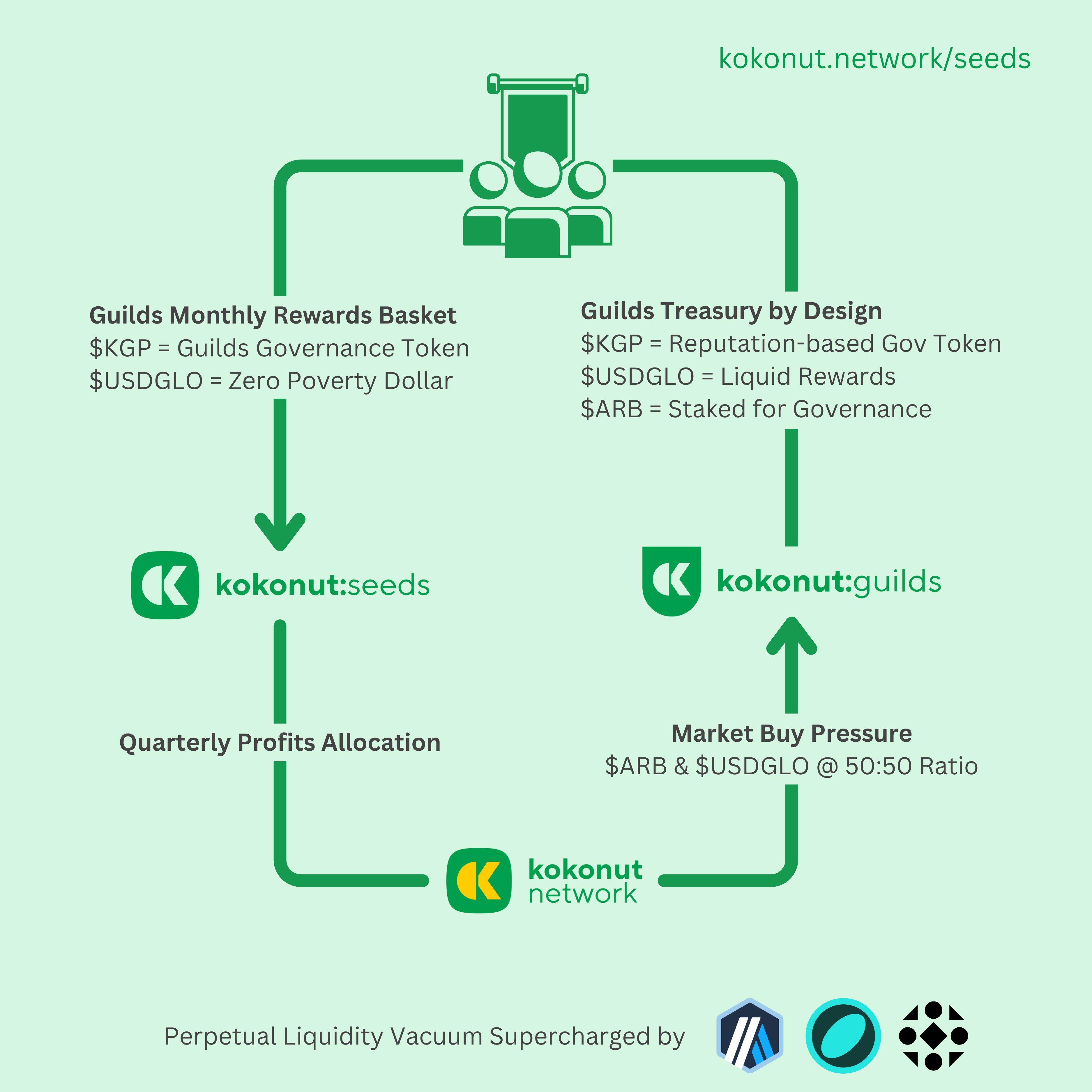
The current Solution page previously described a “perpetual regenerative flywheel” as if revenue necessarily flows through a fixed path. The more accurate model is conditional. A regenerative farm can generate several kinds of value:- farm revenue;
- operator income;
- local employment;
- contributor work;
- public goods;
- ecological outcomes;
- reusable data and knowledge.
What Kokonut deliberately does not centralize
A coordination system can become fragile if it tries to own every decision. Kokonut intentionally leaves several responsibilities distributed.Agronomic judgment stays close to the farm
Local operators and qualified agricultural practitioners remain responsible for field decisions.
Capital does not equal every kind of influence
Moloch governance protects treasury participants, while contribution pathways recognize useful work separately.
Data does not replace context
Dashboards, scores, agents, and remote sensing support decisions but should not erase field observations or local knowledge.
The Framework does not erase local variation
Shared standards improve interoperability while farm implementation remains responsive to place.
Why the solution is inspectable
The strongest evidence for Kokonut is not a claim that the system is complete. It is that important parts can already be inspected.The farm is inspectable
Adelphi has documented land, operators, infrastructure, crops, poultry, MRV workflows, forecasts, and public records.
Capital governance is inspectable
The Moloch DAO, treasury architecture, governance tokens, proposal mechanics, and rage-quit protections are documented.
The methodology is inspectable
The Common Data Schema, development phases, regenerative principles, value framework, and MRV methods are public.
The technical layer is inspectable
Builders can review the public repositories, deployed governance infrastructure, data primitives, and developing agent architecture.
What success would look like
The solution becomes more meaningful when it survives beyond the first farm. Success would mean that a future farm can:- document its local context without copying Adelphi;
- use a shared baseline for onboarding and funding review;
- receive support through an appropriate governance process;
- preserve local operational authority;
- generate structured records from real activity;
- separate forecasts from actual outcomes;
- make important claims inspectable;
- contribute new lessons back into the shared Framework;
- reuse technical and coordination infrastructure that already exists.
The goal is not to reproduce Adelphi everywhere. The goal is to make the next regenerative farm start with more coordination capacity than the first one had.
Continue Kokonut 101
Next: The Kokonut Vision
See what this architecture is intended to make possible over the long term.
Review the Problem
Return to the six coordination gaps this solution is designed to address.
Explore the Framework
Go deeper into shared data, development phases, regenerative principles, impact methods, and MRV.
Build with Kokonut
Explore repositories, contracts, schemas, data primitives, Kokonut Intelligence, and agent-ready infrastructure.