

Adelphi’s physical systems turn the farm model into something that can be inspected.
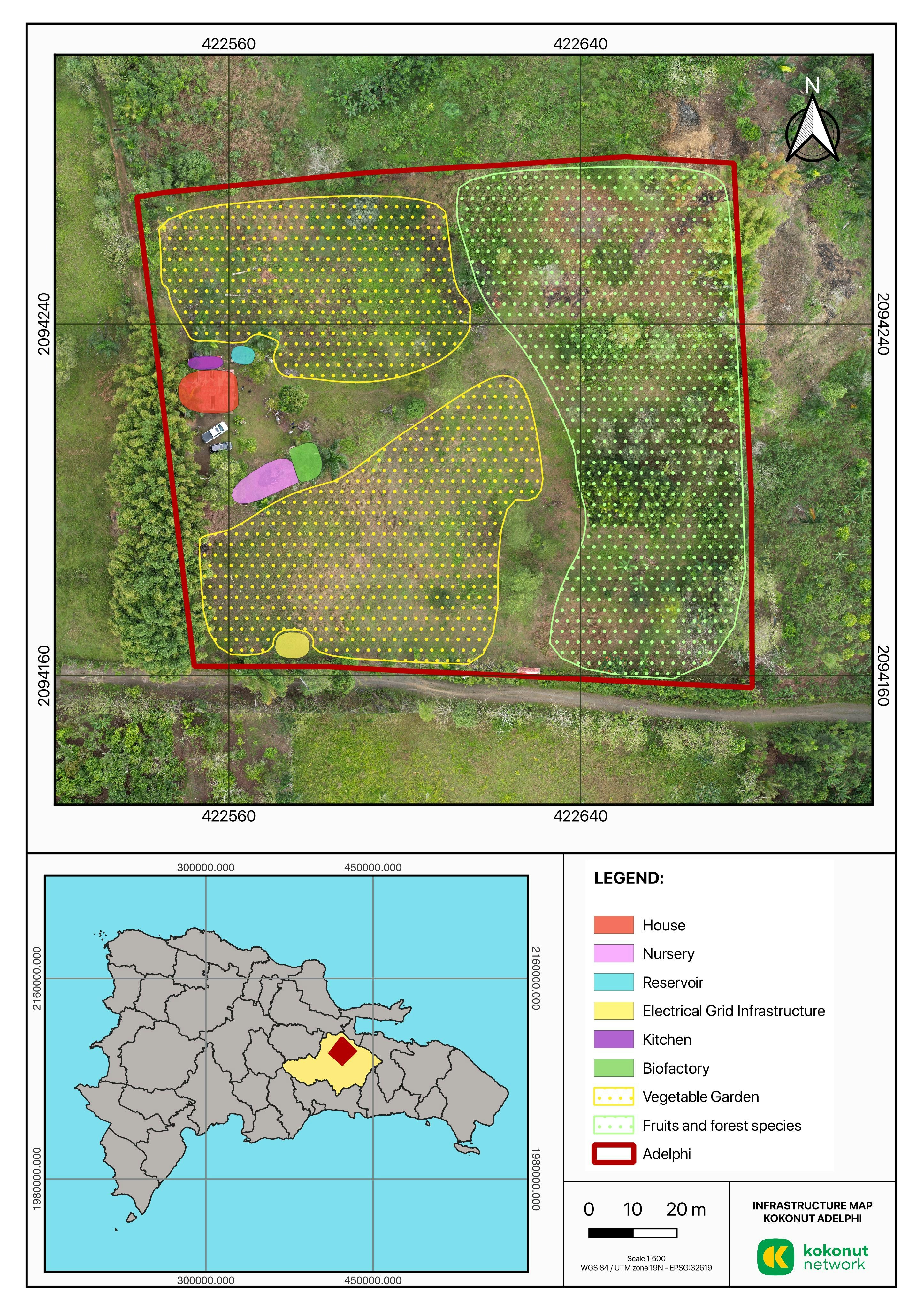
This page documents the physical operating system of Adelphi: crop beds, syntropic plots, perennial species, nursery, biofactory, poultry, soil inputs, training infrastructure, geospatial layout, and market-readiness work. The purpose is not to infer impact from infrastructure alone. It is to show:- what is physically documented;
- what each component is designed to do;
- which outputs are measured versus estimated;
- what evidence would be needed to support stronger ecological, economic, or community claims.
Start with the farm overview
Review Adelphi’s documented state, Framework phase, forecast boundaries, and current evidence model.
Inspect published farm records
Use the Kokonut Hub for current published farm records, MRV events, harvest information, and project data.
Infrastructure is evidence of implementation, not proof of outcome. A nursery proves the nursery exists. A biochar application proves a practice occurred. Claims about biodiversity recovery, soil improvement, food security, or revenue require additional records and measurement.
Documented system at a glance
13,838 m²
Documented agricultural area within Adelphi’s 15,725 m² mapped site.
110 hens
Documented free-range laying-hen component.
~100 eggs/day
Current planning estimate for poultry output, not a substitute for daily production records.
2 syntropic plots
Two plots are documented for full syntropic implementation.
12+ species
Current repository materials identify 12+ native or at-risk species in the nursery and agroforestry system.
1 training gazebo
Multipurpose space for meetings, meals, demonstrations, workshops, and community activity.
Counts such as egg output, nursery inventory, and species status can change. Current records should take precedence over static documentation when newer evidence is available.
The farm system
The system is designed so production, regeneration, inputs, animals, education, and evidence are connected. The strength of any outcome claim still depends on the records generated by those components.Physical systems inventory
Production across multiple time horizons
Adelphi does not depend on one crop cycle.
The mix supports diversification across time.
It does not guarantee diversified revenue.
Actual economic performance depends on:
- survival;
- harvest volume;
- losses;
- prices;
- labor;
- buyers;
- logistics;
- crop timing;
- poultry productivity.
Crop and agroforestry diversity
The current repository documents a mix of food crops, perennial species, and agroforestry plants.Productive species documented in the system
Native and at-risk nursery / agroforestry species documented in the repository
Current farm materials reference species including:- Hispaniola palmetto;
- native cacao;
- guavaberry;
- Congo coffee tree;
- jagua;
- naseberry;
- Star Apple;
- Mammee Apple;
- Custard Apple;
- cashew;
- soursop;
- lipsticktree;
- Florida fiddlewood;
- logwood;
- additional ground-cover and vine species.
- species;
- quantity propagated;
- quantity surviving;
- quantity distributed;
- recipient or destination class;
- date;
- propagation source;
- follow-up where practical.
Nursery and biofactory
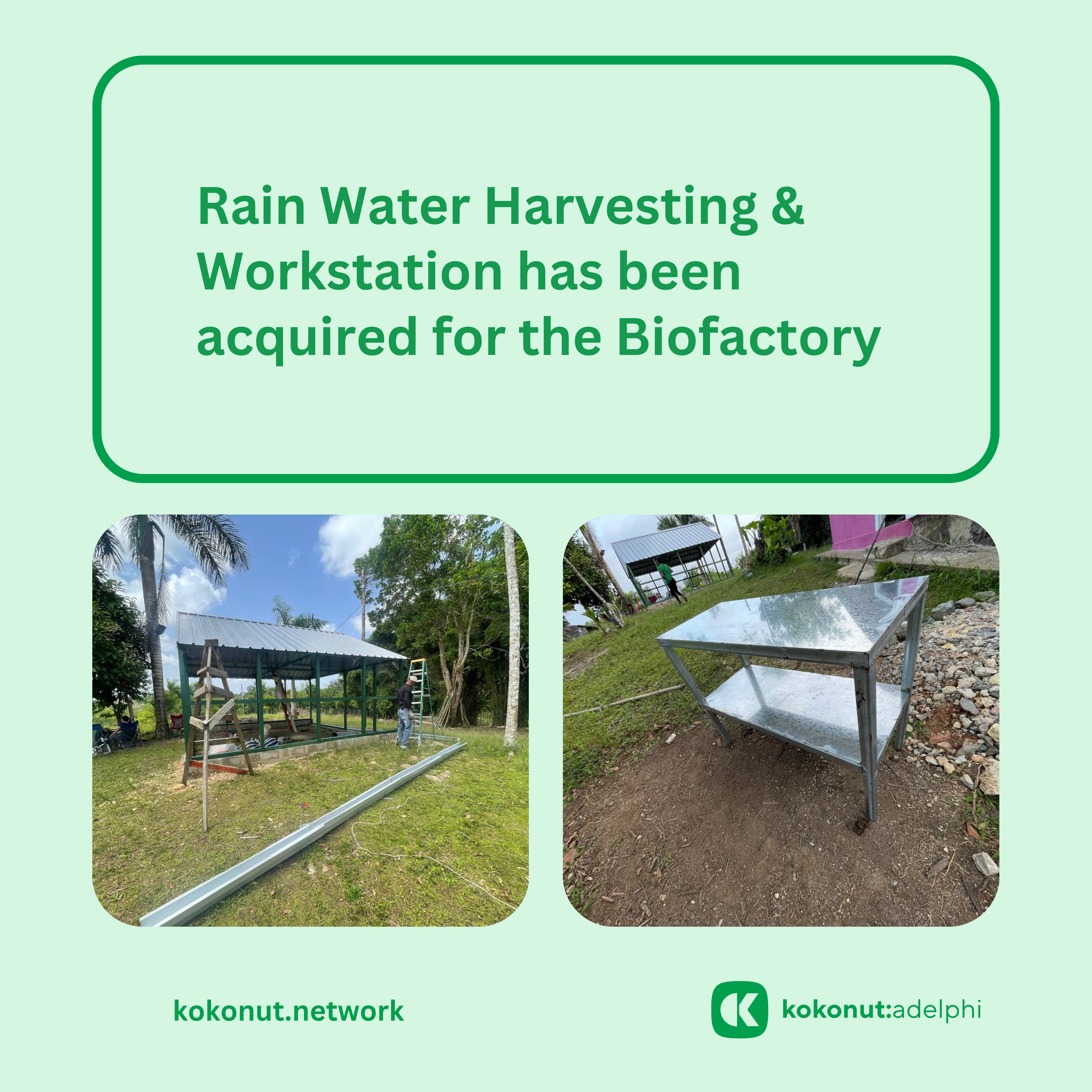
Propagation
Maintain and reproduce productive, native, and at-risk plant material for the farm, education, and distribution.
Biological inputs
Produce farm inputs such as biochar, humic-acid preparations, organic urea, and related biological amendments documented in the Framework.
Biochar and soil-management practices
The repository documents biochar produced from bamboo found around the farm boundary. The documented process uses pyrolysis and incorporates mineral material as part of the farm’s soil-input practice. The intended functions include:- adding stable carbon-rich material to soil;
- supporting nutrient retention;
- supporting water-management objectives;
- creating habitat for soil biological processes;
- reusing locally available biomass.
See the MRV evidence standard →
Syntropic plots and ground cover
Two plots are documented as dedicated syntropic implementations. Their design uses multiple vertical and temporal layers.
The farm also documents vegetative cover along terraced edges, including beard grass.
The intended purpose is to reduce bare soil and support erosion management.
A strong erosion-control claim still requires evidence such as:
- slope/location records;
- ground-cover percentage;
- rainfall period;
- erosion observations;
- before/after imagery;
- sediment or soil-loss indicators where practical.
Why Syntropic Farming
Understand the agricultural logic behind multi-strata, succession-oriented regenerative systems.
5 Principles of Regeneration
Review the shared Framework principles behind soil cover, diversity, perennial systems, animal integration, and organic inputs.
Poultry as production and nutrient infrastructure
Adelphi documents 110 free-range laying hens. The current production model estimates roughly 100 eggs per day or 36,500 eggs per year. The poultry system is designed to provide:- eggs;
- manure;
- forage integration;
- organic matter;
- biological-input feedstock;
- an additional production stream.
Documented nutrient loop
This is best described as a designed nutrient loop. Its efficiency should be evaluated through feed, manure, input, soil, crop, and egg records.Training and community infrastructure
- dining space;
- meeting space;
- training area;
- demonstration area;
- community gathering infrastructure.
- organic and syntropic farming;
- agroforestry;
- nursery propagation;
- biochar and soil practices;
- poultry integration;
- farm-data collection;
- MRV literacy.
- event logs;
- attendance;
- audience type;
- topics taught;
- repeat participation;
- feedback;
- evidence that skills were later applied.
Organic certification and market readiness
The current repository documents Adelphi’s organic certification process as in progress through the Dominican Republic Ministry of Agriculture pathway. That status should be read literally: in progress ≠ certified. Potential distribution channels described in current planning include:- specialized organic-food businesses;
- local and regional supermarkets;
- direct community sales.
Forecasts and market assumptions
Review the price, yield, loss, distribution, and revenue assumptions separately from actual farm performance.
Adjacent land is now a separate replication case
Older Adelphi documentation describes adjacent land as a future Adelphi expansion strategy. The current Kokonut 101 and Regenerative Finance documentation now identifies roughly 50,000 m² of adjacent land under agreement as Kokonut Terra Viva, a separate replication case entering Phase I — Planning & Preparation. That distinction matters. Adelphi is the first live reference farm. Terra Viva is the next farm-scale test of whether Kokonut’s shared Framework can move into a new implementation without simply expanding the same farm.Terra Viva — next replication test
Review the currently documented Phase I status and why the adjacent land is treated as a separate implementation rather than part of Adelphi’s existing physical infrastructure.
How each system should become evidence
What this infrastructure demonstrates today
The farm has multiple operating systems
Production, poultry, nursery, biofactory, syntropic plots, training space, and evidence infrastructure exist within one farm context.
Diversification is designed into the farm
Crop timelines, perennial systems, poultry, species propagation, and biological inputs reduce dependence on a single production mechanism.
Regenerative practices are being implemented
Biochar, ground cover, syntropic planting, agroforestry, native-species work, and nutrient cycling are documented practices.
Physical activity can generate structured evidence
Crop, species, poultry, input, geospatial, event, and infrastructure records can feed MRV and public reporting.
What the infrastructure does not prove by itself
- increased biodiversity;
- improved soil function;
- carbon sequestration;
- reduced erosion;
- lower input costs;
- higher yield;
- reliable market access;
- realized farm profitability;
- improved community learning;
- local food-security impact.
Continue through Adelphi
Crops & Harvest Forecast
Review the production formulas, loss assumptions, prices, yield forecasts, egg estimate, and forecast-vs-actual logic.
MRV — Evidence Standard
Understand how these physical systems should generate observations, measurements, reviewed records, attestations, and interpretations.
Adelphi Problem & Solution
See which implemented systems respond to documented constraints and which intended outcomes still need evidence.
Sustainable Development Goals
Connect crops, jobs, biodiversity, women-led operations, and community infrastructure to explicit SDG evidence requirements.
Why Syntropic Farming
Read the agricultural methodology behind the farm’s multi-strata and succession-oriented design.
Open Collaboration
Contribute to agronomy, biodiversity records, soil methods, infrastructure documentation, MRV, data quality, or farm tooling.
The physical system matters because it creates the conditions for outcomes. The evidence system matters because it tells us which outcomes actually occurred.